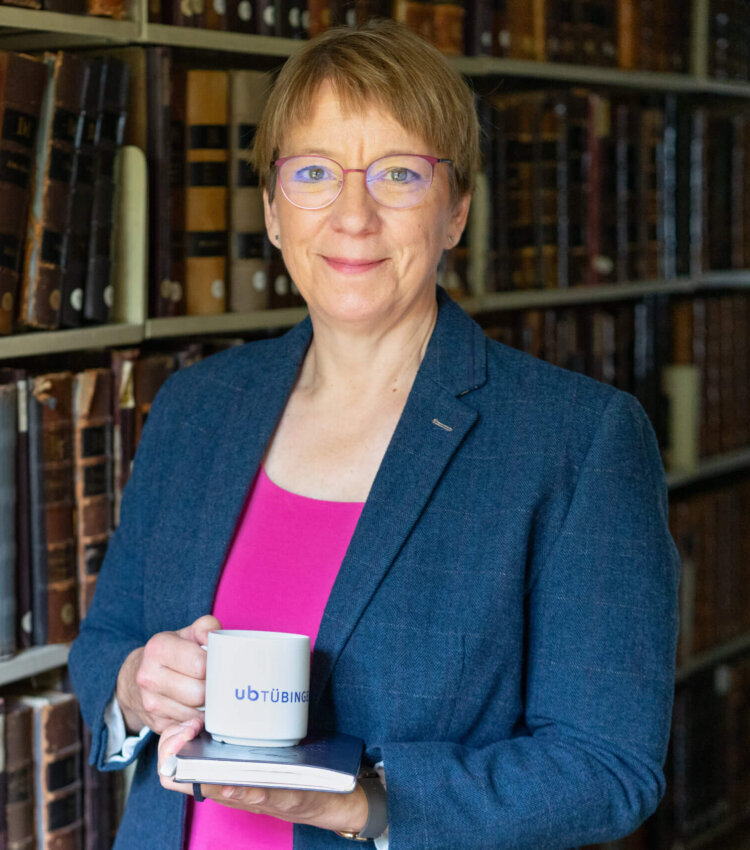
Ulrike Küsters (Dipl.-Geol) – University Library Tübingen, IT Department, Head of Open Science Research Publishing
Professional background & career.
My path into the library world began more or less incidentally – and only really became clear to me in retrospect. During my geology studies at RWTH Aachen University, I started looking for a student assistant job early on to supplement my student loans. I found it in the library of the Geological Institute – surprisingly, not supervised by a traditional librarian, but by the Professor of Regional and Historical Geology. An unusual all-rounder: "self-made librarian," author, organizer, networker. He supported local history societies and communities in the design of visitor mines and sites of significant mining history – an early precursor to what we might now call citizen science. I organized excursions, worked in the library, proofread his publications – and in the process, developed a feel for what we now call meta-competencies: organizing, editing, publishing, informing.
To complete my studies, I managed to spend a year at Imperial College London as part of a special construct between a German diploma and a British master's degree. A doctorate was not an option after that for financial reasons. Instead, I started working for an engineering firm – formally self-employed, de facto employed. At that time, legal protection against bogus self-employment was still sketchy. I reoriented myself and completed an IT apprenticeship to become a certified database developer and web programmer. This opened up the IT job market of the early 2000s – including a stint in the R&D department of Ericsson Eurolab. A few years later, I moved to the library of the Philips research laboratories in Aachen and Eindhoven as an internet and information editor. There I worked on topics related to laboratory publications, publishing contracts, patent protection, and managed the intranet as well as an in-house publications repository – technically innovative and ahead of its time. During this phase, it became clear to me: information structures and publication culture are central components of modern science – and librarians are needed everywhere, whether in universities or in industrial research, whether organizationally located in an IT department or in a library. What matters is not where the role is located, but that it is there – as a creative, reliable, and structuring force in the background.
In 2009, I moved to the Fraunhofer Information Center for Spatial Planning and Building (IRB) in Stuttgart. Over the course of 15 years, I developed a small team into a strategic service support unit for the entire Fraunhofer-Gesellschaft, helping to launch the open access policy. Later, I expanded to include topics such as research data management, research information systems, bibliometrics, and ongoing consulting on publication practices. This consulting function became increasingly multifaceted over time: It was no longer aimed solely at individual publishers, but increasingly also at decision-makers at the management levels of the institutes. Issues such as visibility, compliance, infrastructure selection, and cost control made it clear that publication consulting is now always a starting point and a strategic element of academic management—and thus a central component of modern library work.
Hier mehr über die Universitätsbibliothek Tübingen erfahren.
Bildnachweis Beitragsbild Ulrike Küsters: © Lorenz Leins, UB Tübingen
Personal experiences.
What was particularly exciting about this position at Fraunhofer was the opportunity to network with other organizations – and learn a great deal from them. In working groups at DINI, the Alliance of Science Organizations, and the NFDI consortia, I experienced how intensive the exchange between academic libraries in Germany actually is. Open Access Days, Biblio-Con: I delved deeper and deeper into the library world – and soon realized that not only information but also experiential knowledge, principles, and strategies are shared here. The openness with which colleagues connect through working groups, associations, and networks deeply impressed me – and had a lasting impact on my understanding of library work – and of open science.
Since March 2025, I've truly arrived in the library: The job advertisement for "Open Science Manager" at the University Library of Tübingen sounded like a perfect fit for me. I now work in a place with impressive disciplinary diversity and a high level of specialization – working at the interface between individual needs, digital infrastructure, and strategic goals.
What I particularly value about working in a library is the combination of depth of content, strategic thinking, and—yes—a certain quiet mastery: Much of what works is based on invisible expertise. Infrastructures are created here that are individual, reliable, and connectable—and ideally seem so self-evident that they go unnoticed. Or did you know that in certain disciplines, it's only possible to search a repository like ixtheo specifically for feminist, Catholic literature—or even for individual Bible passages—through customized programming? Such requirements cannot be met with standard software. They require not only technical intuition, but also a deep understanding of the ways of thinking and working of the respective specialist communities—and the ability to develop tailored solutions from this. For me, this is precisely where the special quality of library work lies.
I find it particularly fascinating how differently the specialist communities work: Whether it's geology, theology, ancient Egyptology, or rhetoric – each discipline has its own ideas about what constitutes good information provision, what should be open or protected, and how knowledge is handled. This gives rise to challenges that are often impossible to tackle with standard solutions. What at first glance appears to be seamless services actually requires a high degree of expertise, translation skills, and technical fine-tuning – and the interplay of many "library disciplines." This is precisely where the library becomes a space of possibilities – and that's what makes our work so exciting.
Meaning & added value.
And how do you actually "manage" open science? This question leads to areas of tension that extend far beyond repositories and open access licenses. My personal hashtag of horror at the moment is #Open_Science_in_a_closing_world – it sounds paradoxical, but unfortunately it is becoming bitter reality. Scientific openness today must not only be shaped, but increasingly actively defended. Because we are experiencing a political and social development worldwide in which authoritarian regimes are gaining strength, discourse is restricted, and personal and scientific freedom is being put under pressure – be it through censorship, influence, or economic appropriation. In this environment, open science is no longer a neutral infrastructure issue, but always also a statement: "Openness" requires conditions. It needs infrastructures that cannot be bought up or appropriated. It needs a code of mutual support – and the ability to combine openness with responsibility. Sustainability today also means protection against takeover. Protection against the creeping dependence on a few, market-dominating solutions.
Between science diplomacy, strategic alliances, and the question of how we build sovereign, reliable, and unconquerable infrastructures, much is at stake. Anyone who truly takes open science seriously today must also take a stand – against the closure of spaces, against the loss of participation, and against the political instrumentalization of knowledge.
This is precisely where I see my task: not in the mere management of publication funds – as important as these are for everyday research – but in shaping frameworks that make openness possible and responsible. The challenge lies in maintaining digital sovereignty, coordinating heterogeneous systems, and developing sustainable services across faculties – also in light of the excellence strategy of a university that aims to set international standards. At this interface, I bring not only experience but also conviction.
Added to this is the strengthening of a small, dedicated team within an organization that itself appears to be under increasing pressure to meet expectations. As the belief grows that excellence is inevitably rewarded with ever-increasing funding, it's easy to overlook how scarce human resources actually are—and how burdensome such narratives can be. Resources are always scarce. What's needed is not just structure, but also development, culture—and a willingness to share responsibility within the team. Especially in such areas of tension, it often quickly becomes clear what truly matters: orientation, reliability—and the ability to stay on course despite headwinds.
Sometimes it reminds me of our romantic notions of lighthouses: majestic, solitary, providing orientation—a symbol of vision. But the purpose of a lighthouse is not an idyll. It doesn't represent tranquility, but rather a warning. It's meant to save ships from capsizing and people from drowning. An institution that truly radiates does so not as a sleek image—but by remaining in motion, sending signals, and being able to provide orientation in storms. This, too, is library work in the best sense.
Recommendations.
Warum würden Sie anderen Menschen empfehlen, in der Bibliothek zu arbeiten?
Weil Bibliotheken heute viel mehr sind als Bücher und Datenbanken – sie sind strategische Möglichkeitsräume, die Orientierung bieten in einer Welt, die zunehmend unübersichtlich wird. Wer sich für dieses Arbeitsfeld entscheidet, arbeitet nicht nur mit Wissen, sondern an Strukturen, an Verantwortung, an Zukunftsfähigkeit. Bibliotheksarbeit ist heute ein Ort, an dem Haltung gefragt ist – und Gestaltungswille.
Haben Sie persönliche Empfehlungen oder Ratschläge für diejenigen, die sich für eine Karriere in der Bibliothek interessieren?
Das kommt natürlich ganz auf Sie an: Suchen Sie den Einstieg dort, wo es um echte Herausforderungen geht – wo heterogene Systeme zusammengeführt, digitale Souveränität verteidigt und fakultätsübergreifend tragfähige Services gestaltet werden müssen. In einer Organisation, die international Maßstäbe setzen will, ist das keine Nebenaufgabe. Genau an dieser Schnittstelle kann man mitdenken, mitlenken – und wachsen.Gleichzeitig sind Bibliotheken auch Orte, an denen Vielfalt gelebt werden kann – fachlich, biografisch und menschlich. Sie bieten oft Raum für andere Perspektiven: für Menschen mit unkonventionellen Lebensläufen, für neurodivergente Kolleg:innen oder solche, die ihre Stärke eher in der Tiefe als im Rampenlicht entfalten. Bibliotheken funktionieren nicht über Lautstärke, sondern über Substanz – das macht sie zu wertvollen Arbeitsorten für viele, die in anderen Kontexten weniger gesehen werden.
Welche spezifischen Fähigkeiten oder Qualitäten sind Ihrer Meinung nach wichtig, um erfolgreich in diesem Berufsfeld zu sein?
Technisches Verständnis und strategisches Denken sind wichtig – aber mindestens genauso bedeutsam sind systemisches Arbeiten, kommunikative Übersetzungsfähigkeit und ein Sinn für das Zusammenspiel im Team. Gerade weil Bibliotheken heute viele zukunftsgerichtete Aufgaben übernehmen, wachsen Auftragslage, Taktung und Komplexität häufig schneller als die verfügbaren Ressourcen. Was es dann braucht, ist nicht nur Struktur, sondern auch Entwicklung, Kultur – und die Bereitschaft, Verantwortung gemeinsam zu tragen.
Welche Rolle spielen Teamarbeit und Kommunikation in Ihrer täglichen Arbeit?
Eine entscheidende. Ich arbeite in einem kleinen, hochengagierten Team – und in einer Organisation, die selbst unter wachsendem Erwartungsdruck steht. Ohne Kommunikation, ohne Koordination, ohne gemeinsames Verständnis geht nichts. Bibliotheken sind keine Leuchttürme der Selbstgenügsamkeit. Sie leuchten nicht, um schön auszusehen oder Lust auf Bierkonsum zu erzeugen. Sie sind dafür da, Orientierung zu bieten – besonders dann, wenn es stürmt.
What at first glance appears to be a seamless service actually requires a high degree of expertise, translation skills, and technical finesse—and the interplay of many "library disciplines." This is precisely where the library becomes a space of possibilities—and that's what makes our work so exciting.
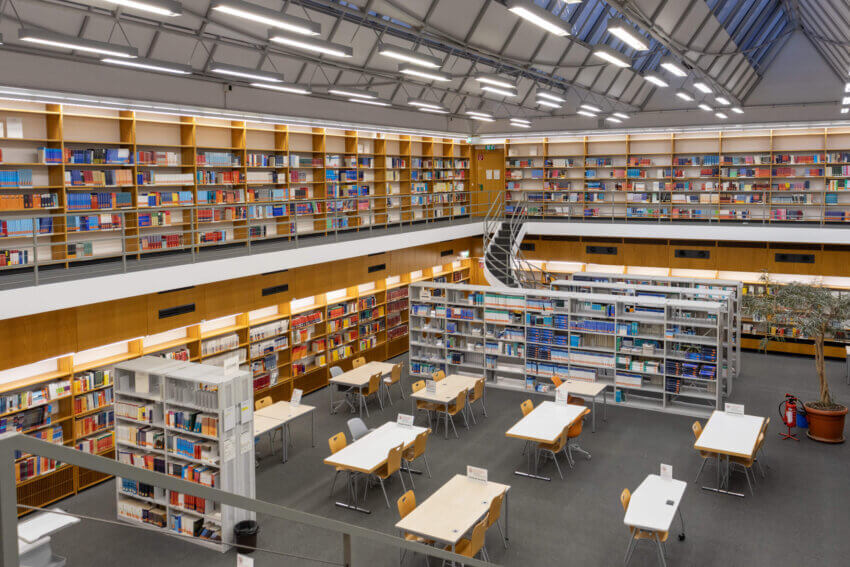
© Lorenz Leins, Tübingen University Library
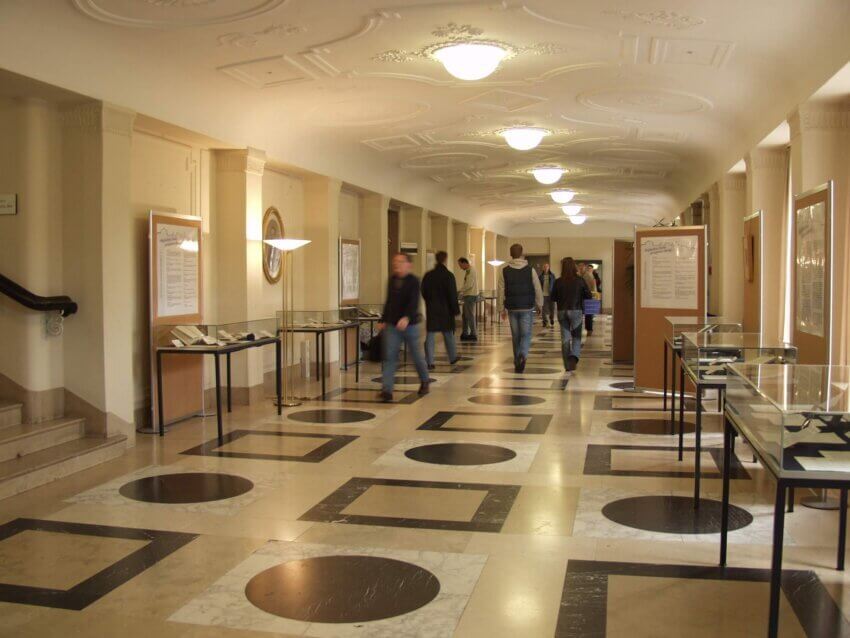
© Lorenz Leins, Tübingen University Library
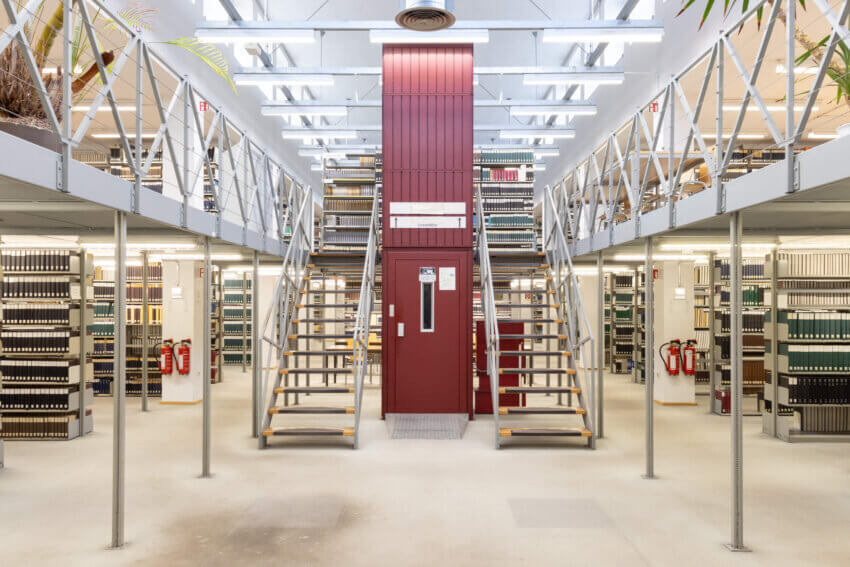
© Lorenz Leins, Tübingen University Library


